Lesson · 2nd Grade
Time
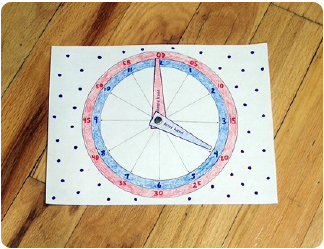
This lesson helps students visualize the "imaginary" numbers by which minutes are read on a clock. The blue hour hand points to the blue numbers, 1–12. The red minute hand points to the red numbers, which count to 55 by fives.
The big idea
Most students can read the hour hand long before they can read the minute hand fluently. The trouble is that a real clock face hides the minute values. The numeral 3 means both "3 o'clock" and "15 minutes," but only one of those is ever printed on the clock. Students are left to mentally multiply by five every time they read the minutes, and many never build that habit.
This project surfaces the hidden minute count in a second color. With the red ring of minute numbers sitting right beside the blue hours, the relationship between the two becomes impossible to miss, and reading the minute hand stops being a memory trick.
Learning objectives
By the end of the lesson, students will be able to:
- Identify which numbers on a clock count the hours and which count the minutes.
- Explain why the minute numbers count by fives.
- Read both the hour hand and the minute hand on an analog clock.
- Use a ruler to draw straight lines from a center point.
Common Core alignment
- CCSS.MATH.CONTENT.2.MD.C.7
Tell and write time from analog and digital clocks to the nearest five minutes, using a.m. and p.m.
Students read the minute hand by counting the five-minute marks the project surfaces in red beside the printed hour numbers.
Materials
- Markers (1 box per student)
- Crayons (1 box per student)
- Starter sheets, page 88 (1 per student)
- Rulers (1 per student)
- Clock hand sheets, page 89 (1 per student)
- Scissors (1 per student)
- Brass tacks (for the teacher)
- The completed project, prepared by the teacher before the lesson
The project
Begin by asking students which numbers (red or blue) are like the numbers on a real clock. (The answer is blue.) Then make sure they understand why their clock will carry a second set of numbers in red: those are the minutes a normal clock keeps hidden.
Students start by using a ruler to connect the center dot on their starter sheet to the dots closer to the clock's edge, making twelve lines. For younger students this is a good opportunity to teach how to use a ruler to draw a straight line. Next, they use red and blue crayons to lightly color the two outer circles.
Students then use red and blue markers to write the red minute numbers (5–55) on the red background and the blue hour numbers (1–12) on the blue background. Finally, they color the hour hand blue and the minute hand red, cut both out, and attach them at the center with a brass tack. Most students will need help with this step. Early finishers can decorate the white area around the clock.
Common student mistakes
- Reading the minute hand as an hour value. A student who reads 3:15 as "three-fifteen" but writes the minutes as 3 is confusing the two rings. The red numbers exist precisely to break this habit.
- Counting minutes by ones. Watch for students who think the next number after the 12 is "1 minute." The red ring shows the jump is five.
Related lessons
Money
Counting nickels by fives to make a dollar reinforces the same skip-counting that reads the minute hand.
The 100 Number Chart
Skip-counting patterns on the chart underpin reading minutes in groups of five.
Multiples
Multiples of five are exactly the numbers around the clock's minute ring.
Fractions
Half past and quarter past connect telling time to early fraction language.