Lesson · 2nd Grade
Addition
The goal of this project is to help students better understand addition by having them deconstruct the number 999 into addends of their own choice. Along the way, it gives them practice reading base-10 blocks.
The big idea
Addends are the numbers in an addition problem that are added together. In the problem 1 + 2 = 3, the numbers 1 and 2 are the addends and 3 is the sum. This project turns that vocabulary into something students can see and touch: they take one large number, 999, and discover how many different ways it can be split into four parts.
Because each student picks their own four addends, no two projects come out alike, and every student has to reason about how their chosen numbers combine to reach 999. That ownership is what makes the place-value practice stick.
Learning objectives
By the end of the lesson, students will be able to:
- Define an addend and a sum.
- Read base-10 arrays for ones, tens, and hundreds.
- Decompose 999 into four addends that sum correctly.
- Check their own work by adding their four addends back together.
Before the lesson: teacher preparation
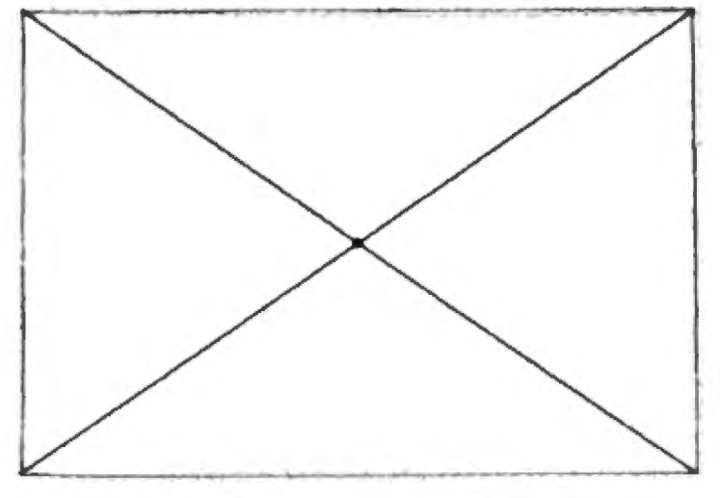
Each student needs a 12" × 18" sheet of construction paper marked with a single guide dot in the center. (This is the same dot-punching method used to prepare the paper for the Money lesson.) The dot is where the four section lines will meet.
Common Core alignment
- CCSS.MATH.CONTENT.2.NBT.A.1
Understand that the three digits of a three-digit number represent amounts of hundreds, tens, and ones.
Reading the array sheet as 9 hundreds, 9 tens, and 9 ones is exactly the three-digit place-value structure this standard describes.
- CCSS.MATH.CONTENT.2.NBT.B.7
Add and subtract within 1000, using concrete models or drawings and strategies based on place value, properties of operations, and/or the relationship between addition and subtraction; relate the strategy to a written method.
Students decompose 999 using concrete base-10 arrays, the kind of drawing and place-value strategy this standard calls for.
Materials
- 12" × 18" construction paper, with a center guide dot pre-punched by the teacher (1 per student)
- Array cutout sheets, page 90 (1 per student)
- Label sheets, page 91 (1 per student)
- Scissors (1 per student)
- Crayons (1 box per student)
- Glue sticks (1 per student)
- The completed project, prepared by the teacher before the lesson
The project
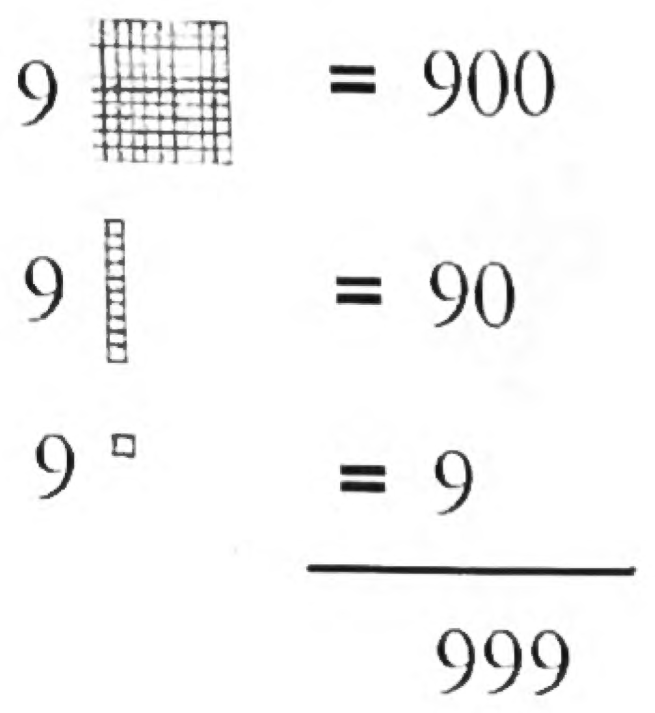
Do not start by showing students a completed project. Instead, hand out only the dotted construction paper and the array cutout sheets. Ask students what number is represented on the array sheet, and help them see that it is 999 by breaking it apart on the board: 9 hundreds is 900, 9 tens is 90, and 9 ones is 9.
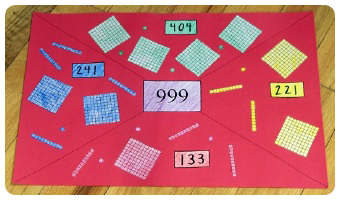
Now show a completed project and explain that students will break 999 into four different addends. Demonstrate with an example whose four numbers add up to 999, and remind students that this is only one of many ways to break the number apart. Require everyone to choose four numbers different from the ones in your example.
Students begin by using a ruler to draw four lines connecting the corners of their paper to the center dot, creating four sections.
They then cut out arrays to form their addends. Have them cut and paste the ones first, since those pieces are small and easy to lose. Students color their ones, tens, and hundreds only after cutting and pasting, using a single color within each section and making sure no two sections share a color. Finally, using the label sheet, they label the total for each section, which is each addend.
Common student mistakes
- Losing the ones pieces. They are tiny. Cut, paste, and color them first so they do not disappear.
- Four addends that do not sum to 999. Have students add their labels back up as a self-check before gluing anything permanent.
- Reusing a section color. Each addend gets its own color so the four parts stay visually distinct.
Related lessons
Place Value
Breaking 999 into hundreds, tens, and ones is place value in action.
Money
Another project that builds large totals out of smaller, color-coded parts.
Multiplication
The base-10 arrays here are the same array model students will use for multiplication.
The 100 Number Chart
Reinforces the tens-and-ones structure that makes decomposing 999 possible.