Lesson · 2nd & 3rd Grade
Fractions
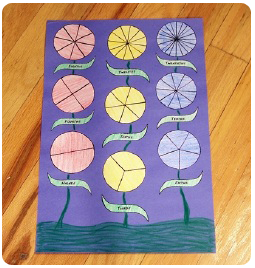
This project is designed to be students' first introduction to fractions. More specifically, it introduces the terms used to describe fraction denominators ("halves," "thirds," "fourths," and so on) through paper flowers that split a whole into ever-smaller equal parts.
The big idea
Too often, teachers begin fraction instruction with examples that consistently show a small numerator and a large denominator. Before long, students believe that numerators can never be larger than denominators, a shallow understanding that leads to real confusion once improper fractions are introduced.
The teacher can avoid this problem by waiting to teach those words. The best place to start fraction instruction is with the simple idea of breaking apart a whole. If we break a whole into four parts, then each of those parts is called a fourth. If we lose one of those parts, we have three fourths left. If we find two more, we have five fourths. In time, students can be adding and subtracting proper and improper fractions before ever even hearing the words numerator and denominator.
Learning objectives
By the end of the lesson, students will be able to:
- Name fraction denominators using the appropriate word (halves, thirds, fourths, fifths, and so on).
- Understand a fraction as a count of equal parts of a whole, and that a whole can be split into more, smaller parts.
- Describe simple equivalences in plain language (e.g. "one half is the same as four eighths").
- Reason about fractions before meeting formal notation like 1/2 or the terms numerator and denominator.
Common Core alignment
- CCSS.MATH.CONTENT.2.G.A.3
Partition circles and rectangles into two, three, or four equal shares, describe the shares using the words halves, thirds, half of, a third of, etc., and describe the whole as two halves, three thirds, four fourths.
Splitting the paper flowers into halves, thirds, fourths, fifths, and so on gives students the named equal-share language this grade-2 standard introduces.
- CCSS.MATH.CONTENT.3.NF.A.1
Understand a fraction 1/b as the quantity formed by 1 part when a whole is partitioned into b equal parts; understand a fraction a/b as the quantity formed by a parts of size 1/b.
Once flowers are split into b equal petals and named (sixths, eighths, twelfths), students have the fraction a/b idea this standard makes formal.
Materials
- Flower sheets (one set of three per student)
- Dark markers or pens (1 per student)
- Crayons (1 box per student)
- Scissors (1 per student)
- 12" x 18" construction paper (1 sheet per student)
- Glue sticks (1 per student)
- Rulers (optional, 1 per student)
- The completed project, prepared by the teacher in advance
The project
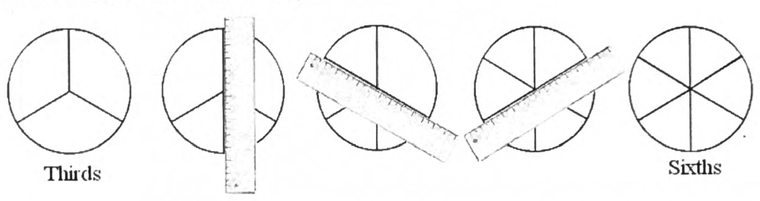
Distribute the three flower sheets and a dark marker or pen to each student. Model how to split the flowers: halves into fourths and eighths, thirds into sixths and twelfths, and fifths into tenths and twentieths, by drawing dividing lines across the petals. A ruler helps with the illustration but isn't strictly necessary for students.
Students then use a different crayon to color each flower group. For example, the fifths, tenths, and twentieths flowers would all share one color. They color the leaf-shaped labels green, cut out their work, and glue it neatly onto construction paper. They can finish by drawing their own stems and grass.
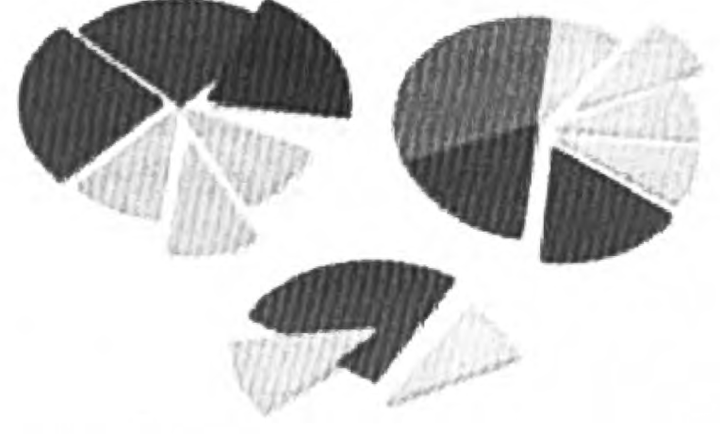
Once the art project is done, the lesson can go in several directions. A natural one is fraction equivalence: How many twelfths equal one third? How many tenths equal two fifths? (Circular fraction blocks, sold by a number of companies, suit this kind of follow-up well.)
A note on language
It's very important that early fraction instruction wait to teach formal terminology and notation. Young students should use only familiar language when referring to fractions. They should be writing sentences like "one half is the same as four eighths" long before they're ever taught that 1/2 = 4/8.
Common student mistakes
- Believing the top number must be smaller than the bottom. This is the exact misconception the lesson is built to prevent. Keep the language about "parts of a whole" and let five fourths feel as normal as three fourths.
- Splitting a flower into unequal petals. A flower cut into uneven parts doesn't represent a fraction. Walk the room and turn these into teaching moments.
- Reaching for symbols too early. If a student writes "1/2," that's fine, but make sure they can also say and write it in words. The words carry the meaning at this stage.
Related lessons
Fractions of a Set
Extends the idea of fractions from a single whole to a collection of objects, the natural next step in 4th grade.
Percents
Converts fractions to decimals and percentages once students are comfortable with parts of a whole.
Place Value
Foundational for later understanding of decimal fractions (tenths, hundredths) and the structure of our number system.
Multiplication
Arrays prepare students to see equivalence (one half = four eighths) as a multiplicative relationship.