Lesson · 2nd, 3rd, & 4th Grade
Place Value
This lesson helps students memorize place values and, perhaps more importantly, lays the groundwork for decimal instruction, one of the most difficult topics to teach in elementary mathematics.
The big idea
Decimals are hard for many reasons. They place importance on a limited set of denominators (tenths, hundredths, thousandths), they are easily confused with negative numbers since both involve numbers less than one, there is no "oneths" place, and unlike other place values, decimal places are not separated into groups of three by commas.
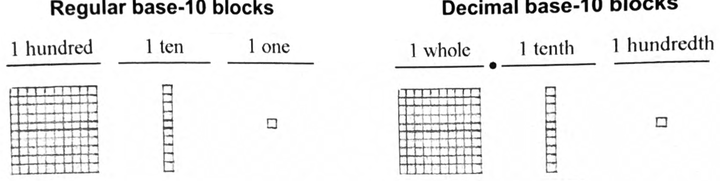
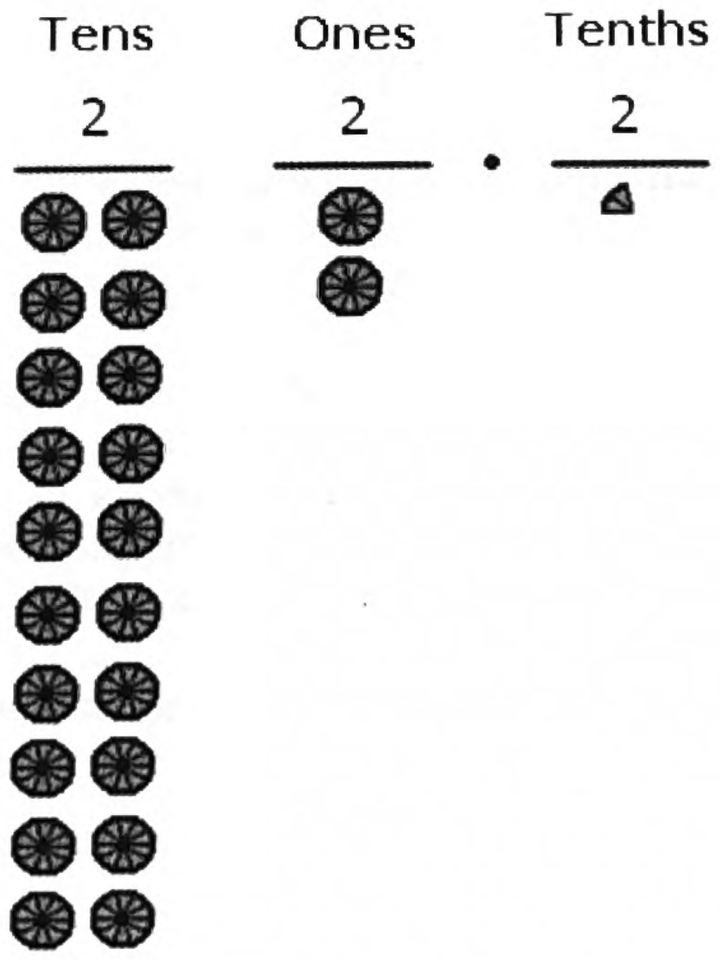
A common classroom shortcut makes this worse: decimal place value is often taught with base-10 blocks that look identical to the blocks used for whole numbers. Reusing the blocks blurs the very difference students need to see. It is safer to tell students that we cannot represent decimals with base-10 blocks because none are small enough. Decimal instruction needs to be tied to whole-number place value, but also clearly differentiated from it: whole number places represent numbers one or larger, while decimal places represent numbers between one and zero. In other words, decimals are simply another way to represent fractions. It is imperative that students understand the difference between tenths and tens, hundredths and hundreds, thousandths and thousands. "Two tens" means two groups of ten; "two tenths" means one thing broken into ten parts, with two of them counted.
Learning objectives
By the end of the lesson, students will be able to:
- Name the place values in order, from millions down to the decimal places.
- Distinguish tenths from tens, hundredths from hundreds, and so on.
- Explain that decimal places represent numbers between one and zero.
- See decimals as a natural extension of the place-value sequence.
Common Core alignment
- CCSS.MATH.CONTENT.4.NBT.A.1
Recognize that in a multi-digit whole number, a digit in one place represents ten times what it represents in the place to its right.
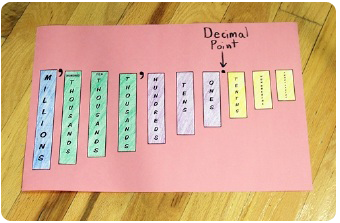
Laying place values out in order with each one ten times the next is the 'ten times to the left' structure this standard makes explicit.
- CCSS.MATH.CONTENT.5.NBT.A.3
Read, write, and compare decimals to thousandths.
The strip extends right of the decimal point into tenths, hundredths, and thousandths, the decimal range this standard names.
Materials
- Place value sheets, pages 111–112 (1 set per student)
- Crayons (4 colors per student)
- Scissors (1 per student)
- Glue sticks (1 per student)
- 12" × 18" construction paper (1 sheet per student)
- Dark markers (1 per student)
- The completed project, prepared by the teacher before the lesson
The project
This project on its own hardly teaches everything students need to know about place value, but it lays a strong foundation for understanding decimals in the context of regular place value. Its strength is its simplicity: it shows place values decreasing at a steady rate, which illustrates that decimals are a natural extension of the place-value spectrum.
Students color the place values according to four groups. The decimal place values are one group, so they all share a color. The ones, tens, and hundreds are a second group; the thousands, ten thousands, and hundred thousands are a third; and millions sits in a group by itself. After coloring the four groups, students cut them out and neatly glue them in order onto their construction paper. They use a dark marker to draw two commas and a decimal point, and they label the decimal point.
Common student mistakes
- Confusing tenths with tens. Hundredths and hundreds, thousandths and thousands trip students up the same way. Keep returning to "two tens versus two tenths" to hold the distinction.
- Expecting base-10 blocks to show decimals. The blocks for whole numbers cannot represent decimals, and pretending they can hides the difference. The color groups in this project keep the two clearly apart.
- Treating decimal places as just more whole-number places. Decimal places count numbers between one and zero, which is a different kind of value, not simply a continuation to the right.
Related lessons
The 100 Number Chart
The vertical jumps of ten on a number chart are place value in action.
Addition
Breaking 999 into hundreds, tens, and ones rests on the same place-value structure.
Percents
Percents and decimals live in the tenths and hundredths places this project introduces.
Fractions
Decimals are another way to write fractions, the bridge this lesson sets up.