Lesson · 4th Grade
Percents
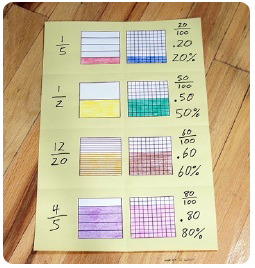
This project teaches students how to convert fractions into decimals and percents. It also has them cut out and color sheets of paper that prove, visually, the equivalence between the original fractions and their converted values.
The big idea
Unlike most Math Art projects, the teacher should not show the completed project until after students have finished their own. Start the lesson by writing four fractions on the board: 12/20, 1/2, 1/5, and 4/5. Ask students, "How do we know which of these fractions is the biggest and which is the smallest? Let's convert them all into decimals and then into percents to find out."
Explain that the word "percent" means "out of 100." To turn these fractions into percents, students first convert each one into an equivalent fraction with a denominator of 100. Convert the denominators first, then go back and convert the numerators. Write the four fractions on the board with a blank box for the unknown multiplier, as shown below, so the class can fill in the pieces together.
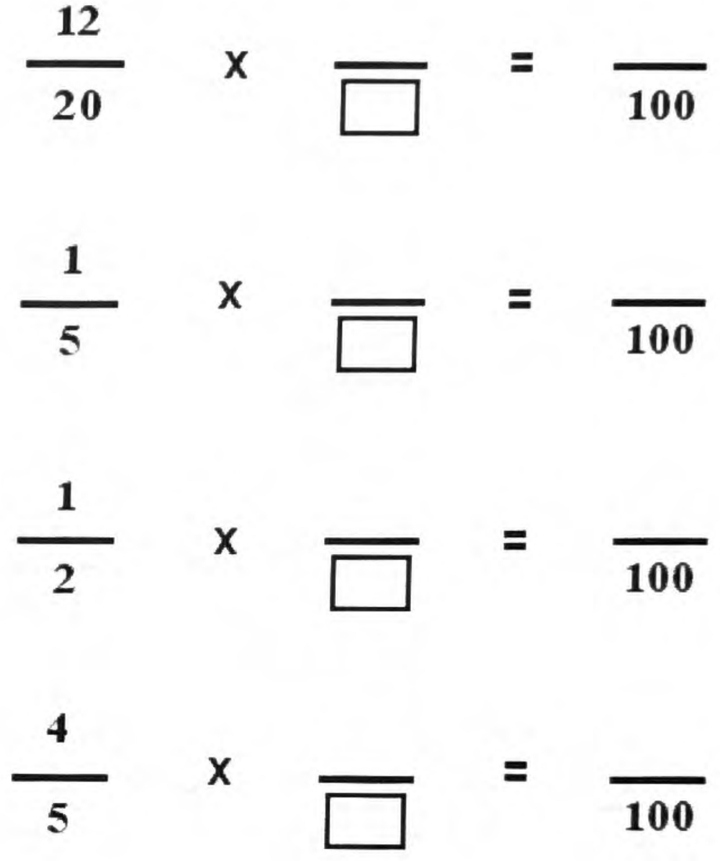
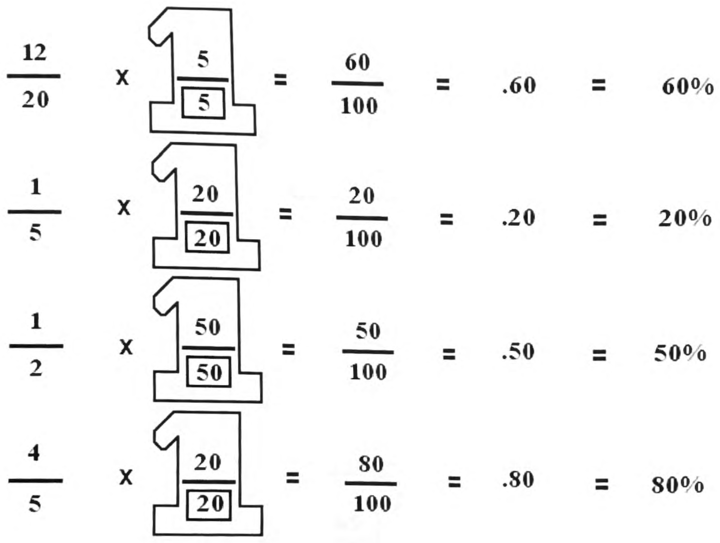
To find a missing value such as the one in 20 times what equals 100, students rearrange it as a division problem (100 divided by 20 is 5), so the denominator must be multiplied by 5. They then multiply the numerator by that same number, which is the same as multiplying the whole fraction by 1, so its value does not change. Once each fraction has a denominator of 100, it is easy to read as a decimal and a percent: 20/100 is .20 and 20 percent.
Learning objectives
By the end of the lesson, students will be able to:
- Explain that "percent" means "out of 100."
- Convert a fraction into an equivalent fraction with a denominator of 100.
- Read that fraction as both a decimal and a percent.
- Order fractions by converting them to a common form.
Common Core alignment
- CCSS.MATH.CONTENT.4.NF.C.6
Use decimal notation for fractions with denominators 10 or 100.
Converting fractions into equivalent fractions over 100 then writing the result as a decimal is the decimal-notation piece this standard names.
- CCSS.MATH.CONTENT.6.RP.A.3.C
Find a percent of a quantity as a rate per 100; solve problems involving finding the whole, given a part and the percent.
Reading 75/100 as 75 percent is the rate-per-100 interpretation this standard formalizes.
Materials
- Fraction sheets, page 145 (1 set per student)
- Percent sheets, page 146 (1 set per student)
- Markers (1 or more colors per student)
- Scissors (1 per student)
- 12" × 18" construction paper (1 sheet per student)
- Glue sticks (1 per student)
- Dark markers or pens (1 per student)
- The completed project, prepared in advance but not shown to the class until late in the lesson
The project
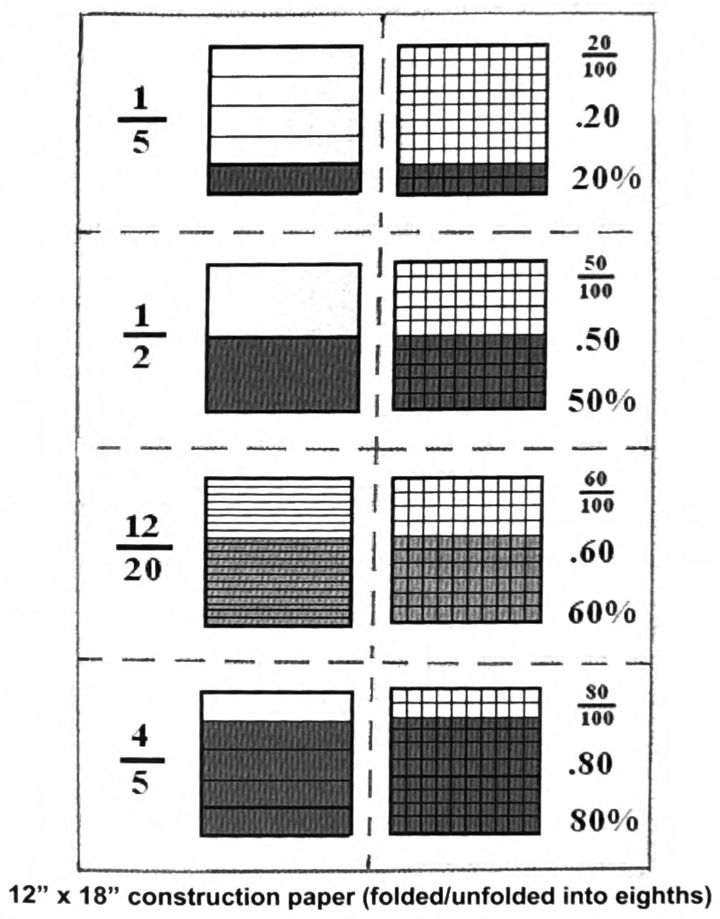
Once the conversions are worked through, show students the completed project. Give each student the fraction sheets and the percent sheets. Students color and then cut out the fraction and percent pieces; it does not matter what colors they use. Next, they fold a 12" × 18" piece of construction paper in half three times and unfold it, creating fold lines that divide the paper into eight sections. Students place equivalent values side by side in those sections, check with the teacher before applying glue, and finish by using a dark marker or pen to label the value of each diagram. To transition into the assessment, the teacher and class practice converting about five to ten more fractions together.
Common student mistakes
- Scaling the numerator by a different number than the denominator. Both have to be multiplied by the same value, or the fraction's value changes.
- Mismatching the cut-outs. Each fraction must end up next to its own decimal and percent, not a neighbor's.
Related lessons
Fractions
The starting point. Percents are just fractions converted to a denominator of 100.
Fractions of a Set
Three-fourths of 100 equals 75, the same bridge to percents this lesson uses.
Money
Cents are hundredths of a dollar, which makes money a natural model for percents.
Division
Finding the missing factor that scales a denominator to 100 is a division problem.