Lesson · 2nd, 3rd, & 4th Grade
The 100 Number Chart
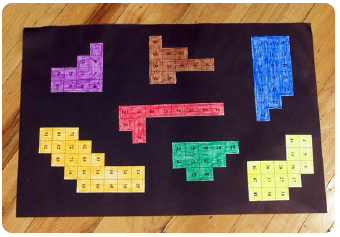
This project helps students recognize patterns in 1 to 100 and 10 to 1000 number charts, especially the less obvious vertical patterns that depend on place value. They build it by turning a chart into a puzzle.
The big idea
Before starting the project, ask students, "What are we counting by if we start at the number 4 and move our finger down the chart?" Count together: 4, 14, 24, 34, and so on. Some students are likely to say we are counting by 4s instead of 10s. Those are the students to focus on once the project begins, because they are either not recognizing the vertical pattern or, worse, do not yet understand place value.
The project has two parts, and the first is the more instructionally significant one. In the first part, students make number-chart puzzles that they can lend to classmates to solve. In the second part, they glue their scrambled puzzle pieces randomly onto construction paper, which is mainly a reward for finishing.
Learning objectives
By the end of the lesson, students will be able to:
- Describe horizontal patterns (counting by ones) on a number chart.
- Describe the vertical pattern (counting by tens) and tie it to place value.
- Reassemble a scrambled number chart using those patterns.
- Explain why moving straight down adds ten, not one.
Common Core alignment
- CCSS.MATH.CONTENT.2.NBT.B.8
Mentally add 10 or 100 to a given number 100–900, and mentally subtract 10 or 100 from a given number 100–900.
The vertical pattern on the chart is exactly the 'add 10' move this standard targets.
- CCSS.MATH.CONTENT.3.OA.D.9
Identify arithmetic patterns (including patterns in the addition table or multiplication table), and explain them using properties of operations.
Reassembling the puzzle relies on recognizing the chart's arithmetic patterns.
Materials
- 1 to 100 and/or 10 to 1000 number charts, pages 98 and 99 (1 per student)
- Crayons (1 box per student)
- Scissors (1 per student)
- 12" × 18" construction paper, optional (1 per student)
- Glue sticks, optional (1 per student)
- The completed project, prepared by the teacher before the lesson
The project
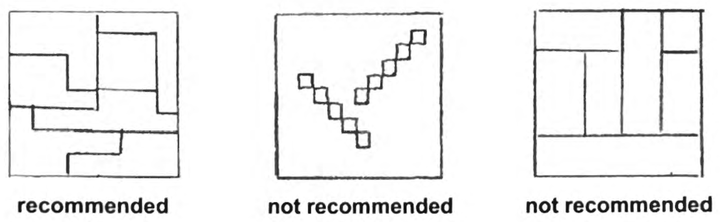
Before cutting anything, students use seven different crayons to color the interiors of what will become seven puzzle pieces. Explain that they should not make any "diagonal" pieces that are connected only at the corners, since such pieces fall apart once cut. Also tell them to avoid making boring rectangle-shaped pieces. Students should show their colored chart to the teacher before cutting it into seven pieces.
After cutting their puzzles apart, students try to put them back together, and the teacher requires them to solve each other's puzzles as well. As an optional last step, students glue their puzzles onto construction paper, and anyone who finishes early can try making a harder puzzle. To transition into the assessment, draw a few questions on the board similar to those on the assessment, have students try them on their own, and then review as a class.
Common student mistakes
- Reading a downward move as plus one. Moving straight down adds ten. This is the exact confusion the lesson is built to expose.
- Diagonal corner-only pieces. They look clever but fall apart when cut. Pieces must connect along full edges.
- Plain rectangle pieces. They make the puzzle trivial. Encourage interesting shapes that still hold together.
Related lessons
Place Value
The vertical jumps of ten on the chart are pure place value, the focus of that lesson.
Multiples
Multiples are traditionally taught on number charts like the ones used here.
Addition
Moving around the chart is adding ones and tens, the same structure built in Addition.
Area
Another lesson where students cut a grid into pieces and reason about how they fit together.