Lesson · 2nd, 3rd, & 4th Grade
Multiples
This lesson builds students' understanding of multiples, especially the difference between "common" and "uncommon" multiples, while reinforcing multiplication facts. The trick is to consolidate many separate multiples charts into a single color-coded sheet.
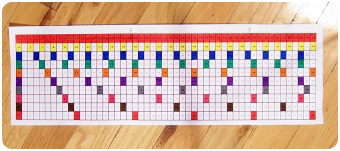
The big idea
Multiples are the numbers that occur when you skip count. The multiples of 4, for instance, are 0, 4, 8, and so on. The topic is normally taught using separate 0 to 99 number charts: a multiples-of-2 chart, a multiples-of-3 chart, a multiples-of-4 chart, and so on. That method is good for spotting general patterns, but it makes specific comparisons hard. To see how often 24 shows up as a multiple, or how rarely 13 does, a student would have to flip through many different charts.
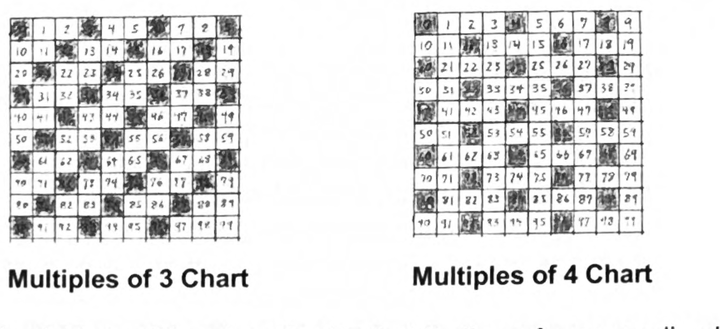
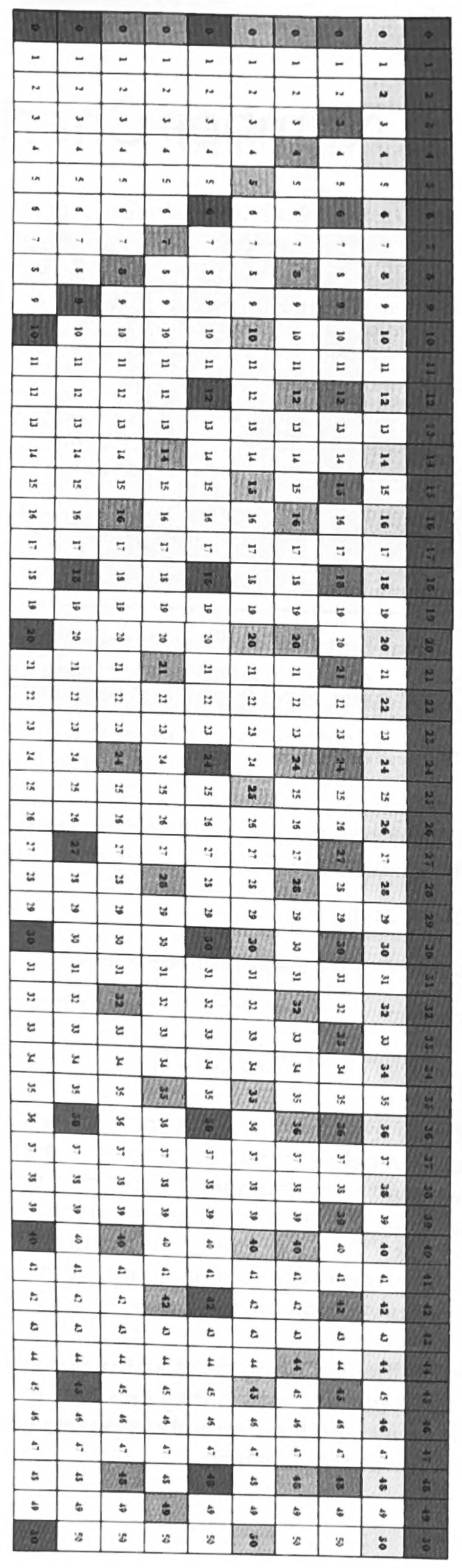
The Math Art method supplements the traditional approach by consolidating the separate charts onto a single (large) sheet. Each chart's contents appear as unbroken, parallel number lines, which makes analyzing an individual number much easier.
Learning objectives
By the end of the lesson, students will be able to:
- Define a multiple and find multiples by skip counting.
- Connect a number's multiples to its multiplication fact family.
- Identify common multiples (numbers colored in more than one row).
- Recognize that 1 has no real multiples, since counting by ones is not skip counting.
Common Core alignment
- CCSS.MATH.CONTENT.4.OA.B.4
Find all factor pairs for a whole number in the range 1–100. Recognize that a whole number is a multiple of each of its factors. Determine whether a given whole number in the range 1–100 is a multiple of a given one-digit number. Determine whether a given whole number in the range 1–100 is prime or composite.
Treating multiples as products in a fact family (and spotting common multiples on the consolidated chart) is exactly the multiple-recognition work this standard names.
- CCSS.MATH.CONTENT.3.OA.D.9
Identify arithmetic patterns (including patterns in the addition table or multiplication table), and explain them using properties of operations.
Color-coding parallel number lines makes the patterns inside the multiplication table visible.
Materials
- Multiples sheets, pages 95–97 (1 set per student)
- Glue sticks (1 per student)
- Markers (1 box per student)
- The completed project, prepared by the teacher before the lesson
The project
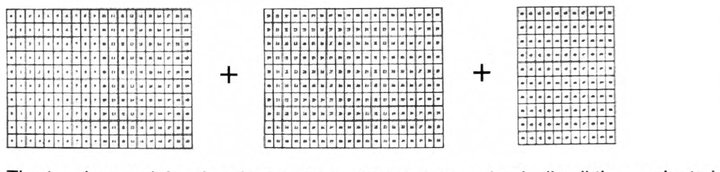
Students (or the teacher beforehand) begin by gluing the three pieces of the chart together. The margins of each sheet can be cut off to create a more continuous chart.
Explain that the multiples of a number are simply the products in its multiplication fact family, and that the quick way to find them is skip counting. Point out that the multiples of 1 are not really multiples, since counting by ones is not really skip counting.
Draw students' attention to the bold numbers on the chart; those are the ones they color. Model coloring a few rows, and hang a poster showing which marker color to use for each set of multiples. As students work, circulate and check understanding. Some students may color the marks without knowing why, so ask questions like, "How do you know you're coloring the multiples of four right now?" If a student answers something like "because it's the fourth row and they're green," they probably do not yet understand. When it is time for a class discussion, make sure every student has a chart in front of them, cutting and gluing a few extra (uncolored) charts for anyone who has not finished.
Common student mistakes
- Coloring by position, not meaning. A student who colors a row because of where it sits, not because the numbers are multiples, has missed the point. Keep asking the "how do you know" question.
- Treating multiples of 1 as real multiples. Counting by ones is not skip counting; make that explicit.
- Missing common multiples. A number colored in two rows (like 6 in both the 2s and the 3s) is a common multiple. Highlight a few.
Related lessons
Multiplication
Multiples are the products in a number's multiplication fact family, so the two lessons reinforce each other.
Square Numbers
Square numbers sit where a number's own multiples line up with themselves.
The 100 Number Chart
The traditional way to teach multiples; this lesson consolidates many such charts into one.
Division
Knowing a number's multiples makes finding its factors, the heart of division, much easier.