Lesson · 4th Grade
Division
This project teaches students the three parts of a division problem: the dividend, the divisor, and the quotient. More specifically, it teaches that the divisor can be understood in two different ways, as the number of groups or as the number in each group.
The big idea
Take the division sentence 40 ÷ 4 = 10. Here the 4 can represent either the number of groups that 40 is broken into (4 groups with 10 in each) or the number in each group (10 groups with 4 in each). This distinction matters in real life. Compare two problems: Jake has 40 M&Ms and wants to give an equal amount to 4 friends (4 people get 10 each), versus Jake has 40 M&Ms and wants to give 4 to as many friends as he can (10 people get 4 each). Both lead to 40 ÷ 4 = 10, but the situations are completely different. Explaining all of this in detail can actually increase confusion, so the goal here is simply that students become aware of the two types of division problem they will meet.
Learning objectives
By the end of the lesson, students will be able to:
- Name the dividend, divisor, and quotient in a division sentence.
- Read the divisor as either the number of groups or the number in each group.
- Match a division problem to a picture that represents it.
- Explain how two different situations can share the same number sentence.
Common Core alignment
- CCSS.MATH.CONTENT.3.OA.A.2
Interpret whole-number quotients of whole numbers, e.g., interpret 56 ÷ 8 as the number of objects in each share when 56 objects are partitioned equally into 8 shares, or as a number of shares when 56 objects are partitioned into equal shares of 8 objects each.
The two readings of the divisor (number of groups vs. number in each group) is the exact quotient interpretation this standard names.
- CCSS.MATH.CONTENT.4.NBT.B.6
Find whole-number quotients and remainders with up to four-digit dividends and one-digit divisors, using strategies based on place value, the properties of operations, and/or the relationship between multiplication and division.
Matching division problems to the picture cards extends the same interpretation to larger dividends.
Materials
- Star sheets, page 151 (1 per student)
- 12" × 18" construction paper (1 per student)
- Division sentence sheets, page 152 (1 per student)
- Scissors (1 per student)
- Glue sticks (1 per student)
- The completed project, prepared by the teacher before the lesson
The project
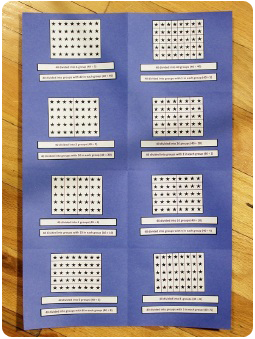
Start by briefly showing a completed project, then remove it from view. Give each student a piece of 12" × 18" construction paper and a star sheet, and have them fold and unfold the paper in half three times to divide it into eight sections. Students cut out the eight star cards and glue one into each section, in the same order they appear on the sheet, leaving a little space underneath each card.
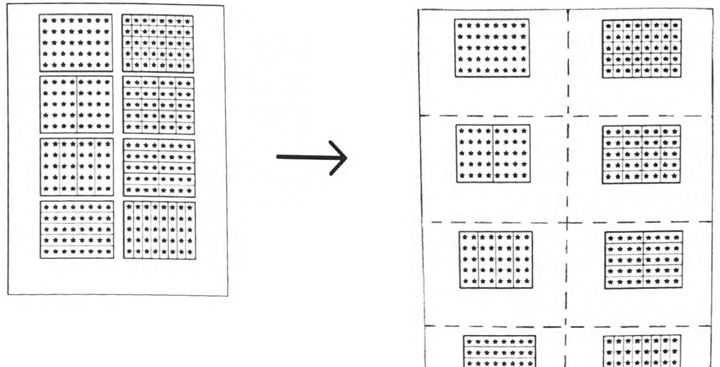
Next, give out the scrambled division problems, which are incomplete because the question at the end of each has been removed (shortened to make matching easier). Explain that some division problems tell you the number of groups while others tell you the number in each group, and that each picture matches one of each type. As an example, have students cut out the top two problems and show that both match the same star card even though they use different numbers (40 ÷ 4 and 40 ÷ 10). Students then cut out the rest, place each problem under its matching picture, and check with the teacher before gluing. Collecting finished projects keeps other students from copying, and once most have finished, the teacher reviews the correct answers one by one with the class.
Common student mistakes
- Reading the divisor only one way. The 4 in 40 ÷ 4 can be the number of groups or the number in each group. Both readings are valid, and each picture pairs with one of each.
- Matching by the numbers alone. Two problems can share a picture with different numbers (40 ÷ 4 and 40 ÷ 10), so students have to think about the type, not just the digits.
- Gluing before checking. Matches go down in pencil first; students confirm with the teacher before anything is glued.
Related lessons
Multiplication
Division is multiplication read backward, so the array model carries over.
Money
Sharing coins (100 cents into 20 nickels) is division in a familiar context.
Fractions of a Set
Finding one-third of a set is the same as dividing it into three groups.
Multiples
Knowing a number's multiples makes its divisors easy to find.