Lesson · 2nd, 3rd, & 4th Grade
Square Numbers
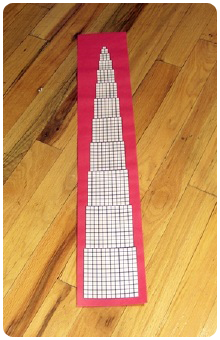
This project is best taught right after the Multiplication lesson. It shows students why a square number is called a square number, by having them build square arrays from 1 by 1 all the way up to 12 by 12.
The big idea
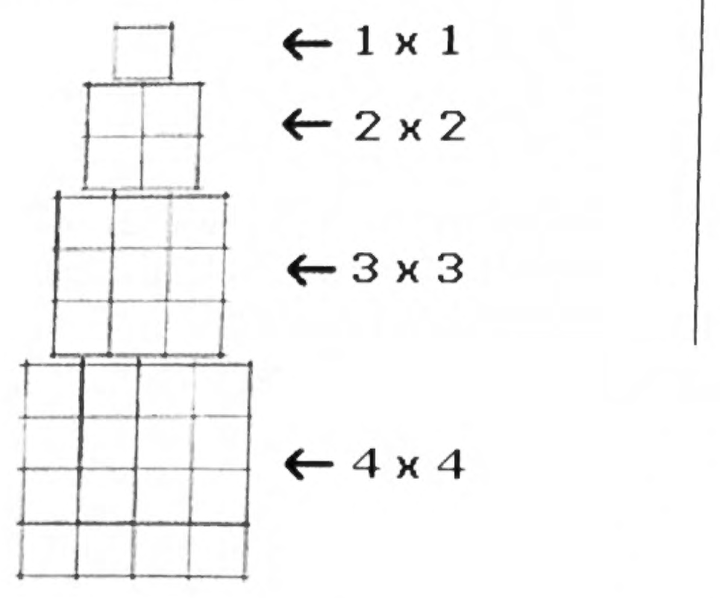
Start by hanging two completed projects on the board: the multiplication project from the previous lesson and the square-numbers project. Ask students, "What is special about the arrays in this project compared to the arrays in the multiplication project?" Help them see that this new project contains only squares. Explain that each square represents a number multiplied by itself, and draw a picture of 1 by 1, 2 by 2, and 3 by 3 to make the point.
Learning objectives
By the end of the lesson, students will be able to:
- Explain that a square number is a number multiplied by itself.
- Recognize that its array is a perfect square.
- Build the square arrays from 1 by 1 up to 12 by 12.
- Connect square numbers back to the broader array model of multiplication.
Common Core alignment
- CCSS.MATH.CONTENT.3.OA.A.1
Interpret products of whole numbers, e.g., interpret 5 × 7 as the total number of objects in 5 groups of 7 objects each.
Square arrays are the natural extension of reading any array as 'this many groups of that many.'
- CCSS.MATH.CONTENT.3.OA.C.7
Fluently multiply and divide within 100, using strategies such as the relationship between multiplication and division or properties of operations.
Building arrays from 1×1 to 12×12 lines up with the multiplication facts students need fluent recall of.
Materials
- Grid paper, page 103 (2 or more sheets per student)
- Scissors (1 per student)
- 12" × 18" construction paper (1 sheet per student)
- Glue sticks (1 per student)
- The completed project, prepared by the teacher before the lesson
The project
The project is made of square arrays from 1 by 1 up to 12 by 12. Students should check with the teacher before pasting their squares, which keeps the focus on getting each square right. The background is made by folding a 12" × 18" sheet of construction paper in half lengthwise, cutting along the fold, and taping the two halves end to end to make a long strip that holds the whole sequence.
Common student mistakes
- Cutting a rectangle instead of a square. A 3 by 4 array is not a square number. Have students confirm the two sides match before cutting.
- Counting the corner twice. The same array-counting caution from the Multiplication lesson applies here.
Related lessons
Multiplication
Teach this first. Square numbers are a special case of the array model students build there.
Multiples
Square numbers sit at the intersections of a number's own multiples.
Area
A square array is also the area of a square, which connects this lesson to measurement.
Perimeter
Another lesson where a shape's size is built up one square unit at a time.