Math Art Projects

Lesson · 2nd, 3rd, & 4th Grade

Symmetry

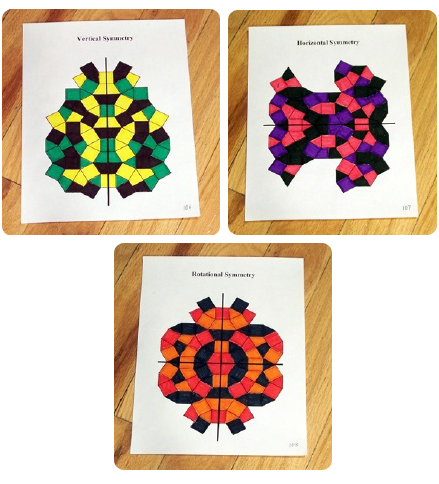
This lesson teaches students how to make symmetrical designs and how to distinguish between vertical symmetry, horizontal symmetry, and rotational symmetry. They color three designs in turn, moving from the easiest type of symmetry to the hardest.
Completed Math Art symmetry project showing a colored design with matching opposite shapes
A completed Symmetry project: opposite shapes share a color, so the line of symmetry is easy to see.

The big idea

Start by offering students a simple definition of symmetry: "an image that is the same on both sides." This definition is not entirely accurate, since from it one could decide that an image with matching sides but no real line of symmetry counts. A more precise understanding forms in students' minds once they begin the project.

Two identical three-petal shapes on either side of a vertical line, looking matched but with no true line of symmetry
Why the simple definition falls short: these halves match, yet neither shape is actually symmetrical on its own.

Hang completed examples of all three symmetry projects at the front of the room, along with the matching uncolored sheets, and use them to summarize the three types:

Three line drawings of the same tessellated design showing a vertical line of symmetry, a horizontal line of symmetry, and both lines together for rotational symmetry
The same design with a vertical line, a horizontal line, and both lines at once, one for each type of symmetry.

Learning objectives

By the end of the lesson, students will be able to:

Common Core alignment

Materials

The project

Tell students they will use three marker colors to make their first symmetrical design. They should start with vertical symmetry, since it is usually the easiest to grasp visually. While working, the most important rule is that any shape they color on one side they must also find and color on the other side. In other words, opposite shapes need to be the same color. Model the coloring of a few opposites. Another way to show the idea is to explain that each shape is the same distance from the line of symmetry as its opposite, which you can demonstrate by drawing arrows on the example. A student is finished only once every shape in the design is colored.

A vertical-symmetry design with a few shapes colored, each colored shape matched by its mirror image on the opposite side of the vertical line
Modeling a few opposites: each colored shape gets a matching partner the same color across the line of symmetry.
The same vertical-symmetry design with arrows drawn from the line of symmetry to a shape and to its opposite, showing both sit the same distance away
Arrows make the point clear: a shape and its opposite are the same distance from the line of symmetry.

Horizontal symmetry comes next. A design with this type of symmetry is usually a little harder for students, probably because, unlike vertical symmetry, it does not line up with the natural symmetry of a person's face and eyes. After a few mistakes, students get the hang of it. Finally, on the last sheet, students create designs with two lines of symmetry, which is rotational symmetry. You can describe it as "finding each shape's three other opposites," since each shape is part of a group of four. It helps to keep all three types of symmetry sheets in an accessible spot, so students who finish other work early can make new designs.

A rotational-symmetry design with both a vertical and horizontal line of symmetry, where four matching shapes form a single group around the center
Rotational symmetry has two lines of symmetry, so each shape belongs to a group of four rather than a pair.

Common student mistakes

Related lessons