Math Art Projects

Lesson · 2nd, 3rd, & 4th Grade

Multiplication

This project is a motivating way of teaching students how to represent multiplication facts as arrays. Students cut out arrays of their own choosing and arrange them into a design, but they have to read each fact aloud before they are allowed to glue.
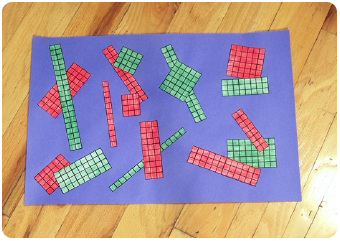
Completed Math Art multiplication project showing colored arrays arranged into a design
A completed Multiplication project: each rectangle is an array, and each array is a fact the student can read.

The big idea

If this is the class's first introduction to multiplication arrays, start with a simple definition. Tell students that one number in a multiplication fact is the amount on the side of the array, and the other number is the amount on the top. A 5 by 4 array, for instance, has five on one side and four on the other.

A 5 by 4 array labeled 5 on the side and 4 on the top reading as 5 times 4, beside a 2 by 6 array labeled 2 and 6 reading as 2 times 6
The number on the side and the number on the top of an array are the two factors: a 5 by 4 array reads as 5 times 4, and a 2 by 6 array reads as 2 times 6.

More advanced classes should begin to see how arrays are linked to the idea of multiplication as repeated addition. A 2 by 6 array is six groups of two, which is 2 + 2 + 2 + 2 + 2 + 2.

A 2 by 6 array with 2 plus 2 plus 2 plus 2 plus 2 plus 2 written across the top and 6 plus 6 written down the side
Reading the same 2 by 6 array as repeated addition: six 2s across the top, or two 6s down the side.

Learning objectives

By the end of the lesson, students will be able to:

Common Core alignment

Materials

The project

Students cut out multiplication arrays with dimensions of their choosing, then glue the arrays into an artistic arrangement. Before gluing, though, each student has to state the multiplication fact each array represents to the teacher or an assisting adult. This makes it impossible for students to create their designs without demonstrating that they can read multiplication arrays. A student gets a glue stick only once the teacher decides they understand the concept. Until then, the teacher and any assistants should be the only people in the room holding glue sticks.

Another way to run the lesson is to give students target products. For instance, tell students they need to find three multiplication facts that each equal 12, 16, 24, 30, 36, and 40. This version is ideal for older students who already understand arrays but need practice memorizing their basic facts.

Common student mistakes

Two grids showing the wrong and right way to number an array, illustrating that the corner square should not be counted twice
Numbering the corner square twice (left) overcounts the array; numbering the rows and columns first (right) keeps the count correct.

Related lessons