Lesson · 2nd, 3rd, & 4th Grade
Shapes
The purpose of this lesson is to help students mentally organize 19 shape names. It is a reinforcing lesson, best taught after students have already had some exposure to most of the shape names, and it sorts them into three distinct categories.
The big idea
Imagine how 19 shape terms must seem to a child who has not yet organized them: right triangle, square, trapezoid, pentagon, octagon, parallelogram, quadrilateral, equilateral triangle, rhombus, heptagon, nonagon, isosceles triangle, acute triangle, rectangle, polygon, obtuse triangle, hexagon, decagon, and triangle. The sheer number is part of the confusion, but so is the way the terms overlap. A square is a type of rectangle, a rectangle is a type of parallelogram, an equilateral triangle is also acute, an isosceles triangle can be acute or obtuse, and all of them are polygons. To have any chance of memorizing and understanding the terms, a class needs a basic organizational framework, which this lesson provides.
Learning objectives
By the end of the lesson, students will be able to:
- Name the polygons from 3 sides (triangle) up to 10 sides (decagon).
- Sort 19 shape names into triangles, quadrilaterals, and other polygons.
- Explain how shape categories overlap (a square is also a rectangle).
- Match each shape to its definition.
Common Core alignment
- CCSS.MATH.CONTENT.3.G.A.1
Understand that shapes in different categories (e.g., rhombuses, rectangles, and others) may share attributes (e.g., having four sides), and that the shared attributes can define a larger category (e.g., quadrilaterals).
Sorting 19 shape names into triangles, quadrilaterals, and other polygons gives students the shared-attribute reasoning this standard names.
- CCSS.MATH.CONTENT.4.G.A.2
Classify two-dimensional figures based on the presence or absence of parallel or perpendicular lines, or the presence or absence of angles of a specified size. Recognize right triangles as a category, and identify right triangles.
Classifying triangles as acute, obtuse, right, scalene, isosceles, and equilateral is the two-dimensional classification this standard names.
- CCSS.MATH.CONTENT.5.G.B.3
Understand that attributes belonging to a category of two-dimensional figures also belong to all subcategories of that category.
Helping students see that a square is also a rectangle, parallelogram, and quadrilateral is exactly the hierarchy this standard formalizes.
Materials
- Shape cut-out sheets, pages 122–124 (1 set per student)
- Crayons (1 box per student)
- Scissors (1 per student)
- 12" × 18" construction paper (1 sheet per student)
- Glue sticks (1 per student)
- A poster with the shape descriptions, made by the teacher
- The completed project, prepared in advance but not shown until midway through the lesson
The project
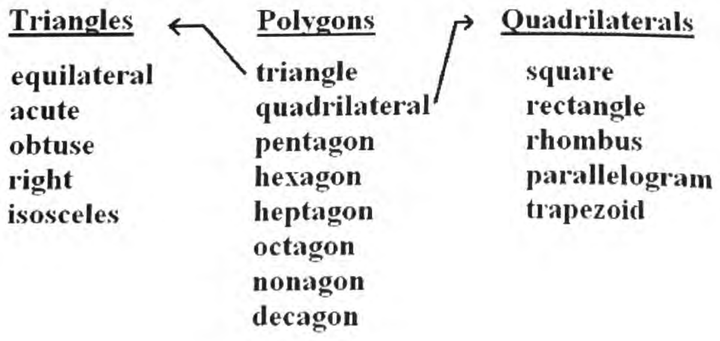
Do not start by displaying a completed project. Instead, with the class, build a list of the eight basic polygon names from 3-sided up to 10-sided. Ask, "What are two-sided shapes called?" (they cannot exist), then three-sided ("triangles"), then four-sided. Many students will say "squares," which is the chance to explain that a square is only one type of four-sided shape and that the name for any four-sided shape is quadrilateral. Continue up to the decagon. Then explain that the first two polygons, triangles and quadrilaterals, are special because they come in many forms, and list the types of each.
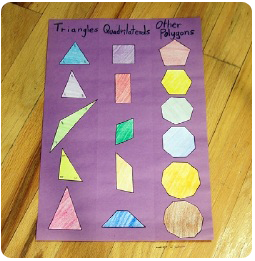
Briefly show the finished project, then put it away and replace it with a large chart that gives the exact definition of each term but shows no pictures. Students color, cut out, and place their shapes in the order they appear on the chart. Folding the construction paper lengthwise into thirds gives three columns that help keep the shapes lined up. Students color each shape before cutting, and they do not paste anything until the teacher has checked that the shapes are in the correct order. They finish by writing the three column headings with a dark crayon.
Common student mistakes
- Calling every four-sided shape a "square." Square is just one kind of quadrilateral. Naming the broader category is the point of the opening discussion.
- Missing the overlap between categories. A square is also a rectangle and a parallelogram. The chart's definitions help students see that one shape can belong to several groups.
- Pasting before the order is checked. Shapes go down in chart order; gluing early locks in mistakes. Have the teacher check first.
Related lessons
Similar Triangles
Goes deeper on one of the three categories sorted here.
Angles
Acute, obtuse, and right triangles are defined by their angles, the focus of that lesson.
Perpendicular & Parallel Lines
Quadrilateral definitions lean on parallel and perpendicular sides.
Symmetry
Many of these shapes are also a study in symmetry.