Lesson · 4th Grade
Fractions of a Set
Although students first need to understand fractions as parts of wholes, eventually they must also understand fractions as parts of sets. This project is a simple but effective way to introduce that idea, by finding three-fourths of grids of different sizes.
The big idea
Early fraction instruction focuses on fractions of a single whole: half a pizza, a quarter of a pie. But fractions also describe parts of a group: three-fourths of a class, two-fifths of a bag of marbles. Students who only ever picture a sliced circle can stall the moment the "whole" becomes a collection of objects.
This project bridges that gap. By keeping each grid fixed and asking students to find a fraction of it, the lesson extends the familiar parts-of-a-whole intuition to parts-of-a-set, without students feeling they've started a brand-new topic.
Learning objectives
By the end of the lesson, students will be able to:
- Count a set of objects using shortcuts rather than counting one by one.
- Find one-fourth of a set, then build up to three-fourths.
- Explain that the "whole" of a fraction can be a group of objects.
- Connect three-fourths of 100 to three quarters of a dollar (75 cents).
Common Core alignment
- CCSS.MATH.CONTENT.4.NF.B.4
Apply and extend previous understandings of multiplication to multiply a fraction by a whole number.
Finding three-fourths of grids of 20, 40, 60, 80, 100, and 120 is multiplying a fraction by a whole number, the exact work this standard names.
Materials
- Grid sheets, pages 147–148 (1 set per student)
- Two markers per student: one dark (for writing labels), one light (for coloring)
- Scissors (1 per student)
- 12" x 18" construction paper (1 per student)
- Glue sticks (1 per student)
- Pencils (1 per student)
- The completed project, prepared by the teacher in advance, with the bottom three-fourths values left out so students can find them on their own
The project
Do not begin by showing students a previously constructed project. Instead, let them examine the grids (the sets) on pages 147 and 148. Ask if they notice something similar about each grid. Some students will see that each one is broken up into fourths. Then ask students to count the total number of small squares in each grid: 20, 40, 60, 80, 100, and 120. Remind them that rather than counting each square individually, they can use shortcuts such as multiplying length by width, multiplying the amount in each fourth by four, or counting by fives. Have students write down the totals so they don't forget them.
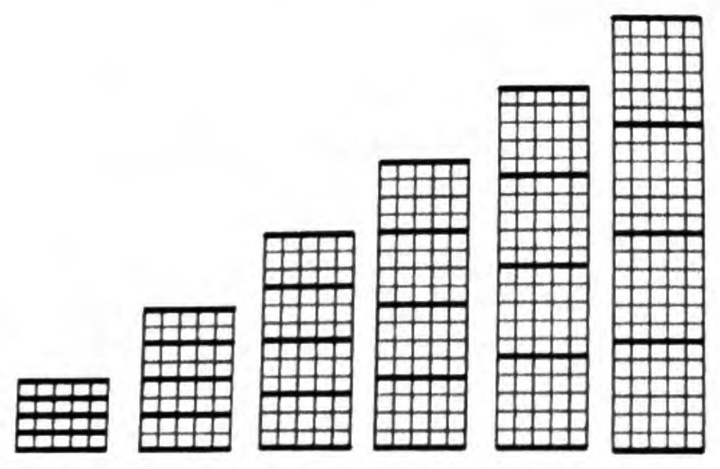
Now have students look specifically at the second-smallest grid. Ask, "If the total number of squares in this grid is 40, what is one-fourth of the total?" Some students will recognize that they can use the thick lines on the grid to find that one-fourth of 40 is 10 squares. Then ask, "If one-fourth of 40 is 10, what is two-fourths of 40?" Show them they can again use the thick black lines, or multiply the squares in one-fourth by two (10 × 2). The same approach gives three-fourths.
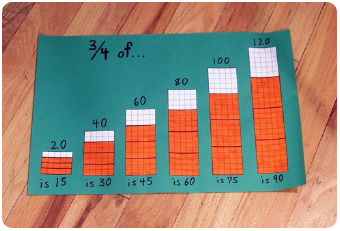
Now ask students to color three-fourths of each grid with the light marker, cutting each one out when finished. Students glue the grids onto 12" × 18" construction paper, leaving open space along the top and bottom of each grid. After gluing, they use a pencil to write each grid's total value above it and its three-fourths value below it, along with the title "3/4 of…". Keep the three-fourths values hidden until the end of the lesson. If you display your own project for reference, cover the solutions at the bottom. Once you've checked that a student's penciled values are correct, they go over the numbers in dark marker.
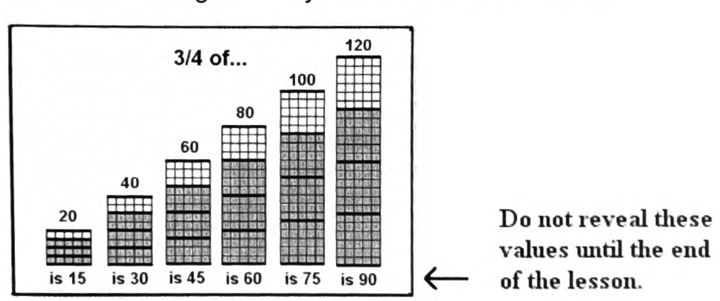
So three-fourths of 20 is 15, of 40 is 30, of 60 is 45, of 80 is 60, of 100 is 75, and of 120 is 90. When students finish, focus their attention on the set of 100. Three-fourths of 100 is 75. Ask, "What does that remind you of?" and help students connect it to three quarters of a dollar equaling 75 cents. With more advanced classes, you can connect the lesson to equivalent fractions: three-fourths can also be written as 15/20, 30/40, 45/60, and so on.
Common student mistakes
- Counting square by square. The shortcuts (length × width, or one-fourth times four) are part of the point. Push students toward them.
- Splitting into unequal fourths. The grid's thick lines already mark equal fourths; remind students to use them rather than guessing.
- Stalling on three-fourths. Students who can find one-fourth sometimes freeze at three-fourths. Show that three-fourths is just one-fourth taken three times.
Related lessons
Fractions
The prerequisite: fractions as parts of a single whole. Students should be comfortable with this first.
Money
Three-fourths of 100 is 75, exactly three quarters of a dollar. The lesson makes that connection explicit.
Percents
The next step: converting fractions into decimals and percentages.
Multiplication
Counting a grid by length × width, and finding three-fourths by multiplying one-fourth by three, are both multiplication.