Lesson · 2nd, 3rd, & 4th Grade
Perimeter
The purpose of this project is to teach students how to find the perimeter of complex shapes. To do it, students surround shapes with linear units (inches) that they paste one at a time.
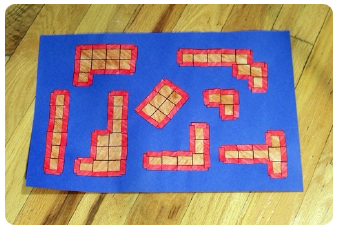
The big idea
This method of finding perimeter is based on the theory that students struggle with non-linear measurement, meaning measurement around corners, because they fail to understand "iterations" of a unit. In other words, they do not recognize that bending a four-inch line has no effect on the line's measured length. This lesson teaches them that four iterations of an inch, regardless of each inch's direction, is what makes a four-inch line.
Learning objectives
By the end of the lesson, students will be able to:
- Find the perimeter of a complex shape by counting inch units around it.
- Explain that bending a line does not change its length.
- Place inch units end to end, overlapping only at corners.
- Tell perimeter apart from area.
Common Core alignment
- CCSS.MATH.CONTENT.3.MD.D.8
Solve real world and mathematical problems involving perimeters of polygons, including finding the perimeter given the side lengths, finding an unknown side length, and exhibiting rectangles with the same perimeter and different areas or with the same area and different perimeters.
Surrounding cut-out shapes with inch units, one at a time, gives students a concrete way to find a polygon's perimeter from its side lengths.
Materials
- Square inch grids, page 107 (1 per student)
- Perimeter grids, page 108 (1 per student)
- Crayons (2 colors per student)
- Scissors (1 per student)
- 12" × 18" construction paper (1 sheet per student)
- Glue sticks (1 per student)
- The completed project, prepared by the teacher before the lesson
The project
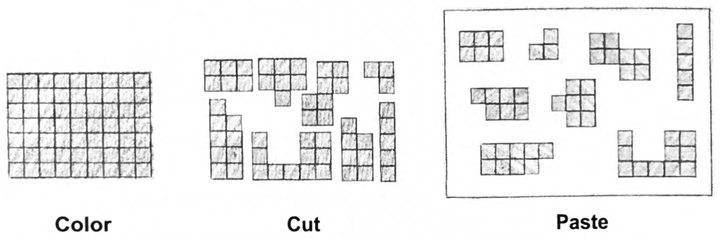
Students start by coloring the entire square-inch grid one color. Next, they cut that grid into roughly six to eight unique shapes, cutting only along the grid lines, and glue these shapes onto 12" × 18" construction paper. Then they use a different color crayon to color the perimeter grid, and from it they cut single inch strips. Students glue those strips one by one around the shapes already pasted down. Make sure they glue the strips end to end, with overlap only when rounding a corner.
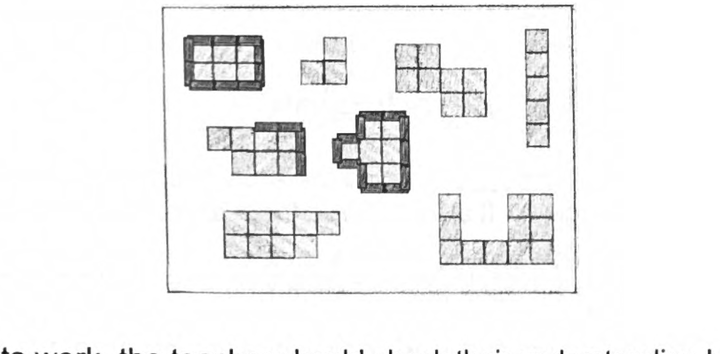
As students work, check their understanding by asking them to state the perimeter of the shapes they have finished. If the class has already learned about area, have them state the area as well. Students often confuse area and perimeter, so it is good to assess both at the same time.
Common student mistakes
- Thinking corners add length. Bending the line of inch units around a corner does not change the count. This is the whole point of the lesson.
- Overlapping strips along straight edges. Units go end to end; overlap belongs only at the corners.
- Confusing perimeter with area. Perimeter is the distance around; ask for both to keep the two straight.
Related lessons
Area
The natural partner lesson; students often confuse the two, so teaching them close together helps.
Multiplication
Later, multiplication becomes a shortcut for measuring; this lesson builds the unit-counting foundation first.
Inch Measurement
Perimeter is built from inch units, so measuring inches first makes the unit concrete.
Shapes
Surrounding complex shapes pairs well with learning to name and classify them.