Lesson · 2nd, 3rd, & 4th Grade
Area
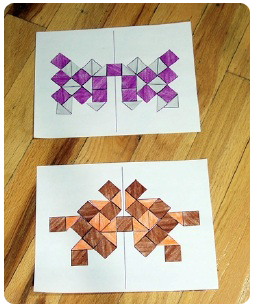
This lesson teaches students to determine the area of unusual shapes, shapes other than basic squares and rectangles, while making symmetrical patterns. Students build each design one square unit at a time.
The big idea
This lesson is designed, in part, to provide an alternative to the often used but problematic way of teaching the difference between area and perimeter. Teachers sometimes say, "When finding perimeter, we add; when finding area, we multiply." If that explanation becomes the basis for understanding, students are sure to be stumped on harder problems.
Perimeter needs to be understood for what it really is, the repetition of linear units around a shape. Likewise, area needs to be understood as the repetition of square units over the surface of a shape. Students should also recognize that if a surface's square units are rearranged or broken apart, the area does not change. Building shapes one square inch and one half-square inch at a time lets students find area by simply counting wholes and halves, which prepares them for later lessons that teach multiplication as another method of finding area.
Learning objectives
By the end of the lesson, students will be able to:
- Find the area of an irregular shape by counting whole and half squares.
- Explain area as square units covering a surface.
- Recognize that rearranging the units does not change the area.
- Keep a design symmetrical while building it.
Common Core alignment
- CCSS.MATH.CONTENT.3.MD.C.5
Recognize area as an attribute of plane figures and understand concepts of area measurement.
Building designs out of whole and half square units gives students area as the count of unit squares covering a surface.
- CCSS.MATH.CONTENT.3.MD.C.6
Measure areas by counting unit squares (square cm, square m, square in, square ft, and improvised units).
Counting the wholes and halves to find the design's area is exactly the unit-square measurement this standard targets.
Materials
- Area sheets, page 109 (1 per student)
- Crayons (2 colors per student)
- Scissors (1 per student)
- Background sheets, page 110 (1 per student)
- Glue sticks (1 per student)
- The completed project, prepared by the teacher before the lesson
The project
Begin by drawing a few shapes on the board and having students discuss, in small groups, the total area in square units of each.
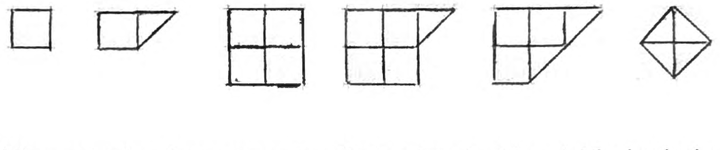
After reviewing those examples, model the opening steps. Show students how to color the area sheet: the half-squares should all be one color and the whole squares all a different color. Cut out a few wholes and halves to begin.

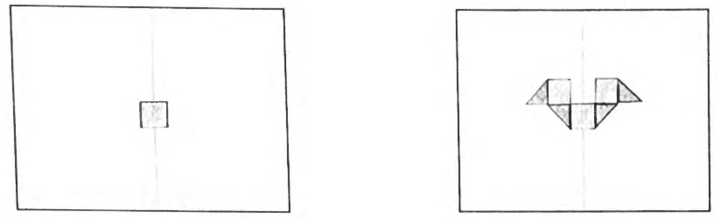
Start a design by pasting a single square inch on the middle line of the background sheet. From there, students are free to paste units anywhere they want, as long as they keep everything connected and maintain symmetry: whatever they paste on one side, they must also paste on the other. As the class works, walk around and ask individual students to state the area of their design so far, watching for students who count half-squares the same way they count whole squares, or who ignore the half-squares altogether. When a student finishes, they write the total area in the lower right corner of the background sheet. Early finishers with leftover squares can switch colors with a classmate and start a new design.
Common student mistakes
- Counting a half-square as a whole. Two halves make one square unit; coloring the halves a separate color helps students track them.
- Ignoring half-squares. Skipping them undercounts the area. Ask for the running total as a check.
- Breaking symmetry. Every unit added on one side needs a partner on the other.
Related lessons
Perimeter
The partner lesson; students often confuse area and perimeter, so teach them close together.
Multiplication
Counting square units now prepares students to use multiplication as a faster way to find area later.
Square Numbers
A square array is the area of a square, linking this lesson to square numbers.
Symmetry
This project requires a symmetrical design, the same skill built in the Symmetry lesson.